From a grass pasture called "the best landing field in the South" to one of America's most dynamic aerospace hubs — this is the story of Piedmont Triad International Airport and the community that built it.
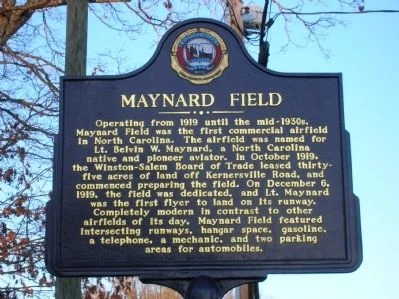
Long before jet engines roared over the rolling hills of Guilford County, the Piedmont Triad was already reaching for the sky. The region's aviation story begins on December 6, 1919, when Maynard Field was dedicated on a patch of land just west of Greensboro, near the community of Oak Ridge.
Named for Lieutenant Belvin W. Maynard — the legendary "Flying Parson" who discovered his love of aviation while studying divinity at Wake Forest College — the airfield was one of the first commercial airports in the American South. With two intersecting runways measuring just 1,890 and 1,249 feet, a humble hangar, and torches lit at dusk to guide pilots home, Maynard Field was a testament to the pioneering spirit that would define this region for more than a century.
Maynard himself was a genuine American hero. As a test pilot in France during World War I, he set a world record for loop-the-loops, performing an astonishing 318 loops without losing altitude. After the war, he won a transcontinental air race, crossing North America in 83 hours and 20 minutes — a record that made him a household name and earned him the enduring nickname among his fellow aviators.
✈
Historic Maynard Field, circa 1919
Maynard Field near Oak Ridge, NC — one of the first commercial airfields in the American South.
By 1922, Maynard Field had competition. To the west, Miller Field opened in Winston-Salem, and Charles Field, a single grass airstrip used mainly for barnstorming and flight training, added to the growing network of landing sites in the Piedmont. The age of aviation had arrived in North Carolina, and the region's communities were racing to claim their place in it.
✈ ——— ✈
Chapter Two
The Great Airport Rivalry: Winston-Salem vs. Greensboro
In 1927, the question of where to build the Piedmont region's primary airport set off one of the most spirited civic battles in North Carolina history. The Tri-City Airport Commission, representing Greensboro, High Point, and Winston-Salem, was formed to select a location for a joint regional airport that could serve all three cities.
The commission selected 112 acres near the community of Friendship, just west of Greensboro. The site had the advantage of flat terrain, room for expansion, and a central location between the three cities. Noted racing pilot Captain Roscoe Turner famously evaluated the site and declared it "the best landing field in the South."
"The best landing field in the South."
— Captain Roscoe Turner, famed racing pilot, on the Friendship site
Winston-Salem, however, was not pleased. Having invested in its own Miller Municipal Airport and boasting the influential backing of the Reynolds tobacco empire, the city refused to contribute funds for the Friendship location. This decision effectively nullified the Tri-City Airport Authority and set the two communities on separate aviation paths for decades to come.
Undeterred, Greensboro and Guilford County jointly purchased the Friendship property from Paul C. and Helen G. Lindley. On May 28, 1927, the new airport — christened Lindley Field — formally opened before a crowd of 12,000 people. The field had no runways, no lights, no hangar, and no passenger station. But it had something that would prove far more valuable: a community's belief in the future of flight.
That belief would be validated just five months later, when the most famous aviator in the world touched down on the Friendship pasture.
Chapter Three
The Day Lindbergh Came to the Piedmont
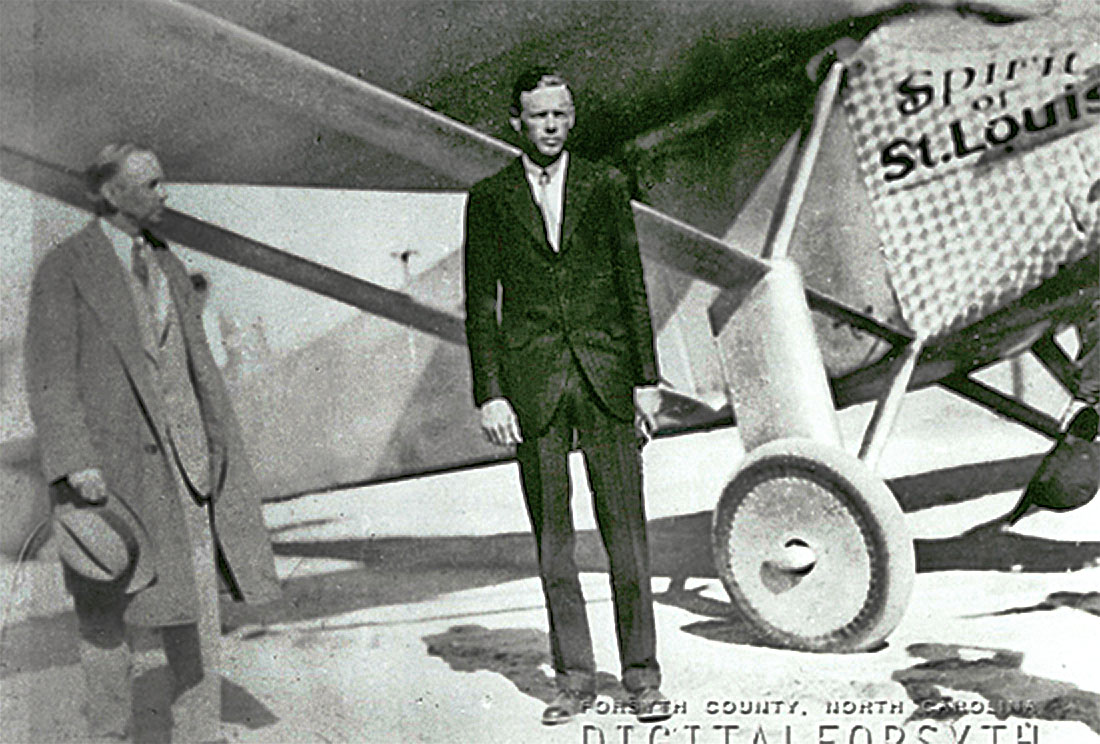
On October 14, 1927, barely five months after his historic solo flight across the Atlantic Ocean, Charles A. Lindbergh landed at Lindley Field in the Spirit of St. Louis.
Lindbergh's visit to the Piedmont Triad was part of the Daniel Guggenheim Fund aviation promotion tour, a nationwide barnstorming campaign following his legendary New York-to-Paris crossing. The purpose was to build public support for aviation, airports, and airmail service across America — and the crowds that gathered in the Piedmont showed that the message was resonating.
But Lindbergh's connection to the Piedmont ran deeper than just the Greensboro stop. Earlier that same month, the Lone Eagle had also visited Winston-Salem, landing at Miller Municipal Airport. The visit electrified the Twin City: tens of thousands of people turned out to see the young aviator and his famous airplane. Local leaders seized the moment to promote aviation and expand air facilities in the region.
✈
Charles Lindbergh & the Spirit of St. Louis
Charles Lindbergh visited both Winston-Salem and Greensboro in October 1927, galvanizing public support for aviation across the Piedmont.
The significance of Lindbergh's Piedmont tour cannot be overstated. His visits to both Winston-Salem and Greensboro validated the region's aviation ambitions and helped secure public support for the infrastructure investments that would follow. Within a year of his visit, Lindley Field became a stop on the eastern airmail route, and the first bags of airmail were delivered to North Carolina.
On May 1, 1928, pilot Sid Malloy, flying for Pitcairn Aviation, landed at Lindley Field at 8:15 p.m. carrying two bags of incoming mail. He loaded three sacks of outbound mail and flew on to Atlanta. It was the first delivery of airmail in North Carolina history, and one of the earliest official airmail routes in the United States. The connection between the Piedmont and the rest of America — by air — had been established for good.
✈ ——— ✈
Chapter Four
Smith Reynolds Airport: Winston-Salem's Proud Aviation Legacy
While Greensboro's Lindley Field grew into the region's primary commercial airport, Winston-Salem carved out its own distinguished chapter in Piedmont aviation history.
Miller Municipal Airport, funded in part by a $17,000 contribution from local businessman Clint Miller, opened in 1927 — the same year as Lindley Field. Its early years were defined by Reynolds Aviation, established by Richard "Dick" Reynolds of the R.J. Reynolds tobacco family. From 1927 to 1933, Reynolds Aviation provided commuter flights to New York, Detroit, Philadelphia, and Baltimore, with weekend taxi service to Wrightsville and Myrtle beaches — connecting Winston-Salem's business class to the broader nation.
In 1940, Charles Norfleet, president of the Airport Commission, negotiated with Eastern Airlines to add Winston-Salem to its north-south route network. To support this landmark agreement, the Z. Smith Reynolds Foundation donated funds to modernize and expand the airport. On December 14, 1942, the airport was rededicated as Smith Reynolds Airport, honoring Zachary Smith Reynolds — Dick Reynolds's younger brother, a daring young aviator who had died tragically at just 20 years of age.
The new terminal was a gem. Designed by Chicago architect Howard Lovewell Cheney — who modeled it after his design for the National Airport in Washington, D.C. — the building featured marble walls, huge picture windows, and a unique chandelier in the lobby. Some called it the finest airport facility in the country.
Smith Reynolds Airport gave birth to Piedmont Airlines. In 1940, Thomas Henry Davis transformed his Camel City Flying Services into Piedmont Aviation, and by 1947, Piedmont Airlines was born as a division of Piedmont Aviation. The airline would grow into one of America's major carriers, serving the small airports that larger airlines skipped — and all of it began at a modest airfield in Winston-Salem.
By 1963, Smith Reynolds was the most active airport in North Carolina and the 85th most active in the entire country, with more than 129,000 annual operations. Though commercial passenger service eventually shifted to the larger Greensboro facility, Smith Reynolds Airport continues to serve as the state's leading general aviation airport, generating nearly $900 million in economic impact and supporting more than 3,000 jobs.
From a Depression-era closure to the jet age, from World War II training base to the largest commercial airport in North Carolina — the mid-twentieth century transformed the humble Friendship pasture into a powerhouse.
1930
Pitcairn Aviation becomes Eastern Air Transport
Passenger service is inaugurated by Dixie Flying Service with a route to Washington, D.C. Eastern Air Transport takes over, launching service connecting 16 Eastern Seaboard cities — including North Carolina's first passenger service from the Triad.
1941
The Airport Authority Is Born
The North Carolina General Assembly creates the Greensboro-High Point Airport Authority to own, operate, and manage the airport. Joseph T. Martin is elected the authority's first chairman.
1942–1945
World War II: The Army Air Corps Takes Over
The airport becomes a hub for the Overseas Replacement Depot (ORD), a refueling station, and a training site for fighter and bomber pilots. The Army builds a second steel hangar and control tower, and lengthens the runways considerably.
1958
A Modern Terminal for a Modern Age
The airport unveils its new 34,000-square-foot terminal, a modern glass-paneled structure with seven aircraft gates, a restaurant, bank, operations office, and counters for tickets and rental cars. The airport is now served by Eastern, Piedmont, and Capital airlines.
1968
United Airlines Brings Jet Service to North Carolina
United Airlines begins its first jet passenger service in North Carolina with flights from Greensboro to Newark aboard Boeing 727 tri-engine planes. Under Executive Director Roger Sekadlo, the Airport Authority adopts a bold $63 million master plan to completely relocate and modernize the airport.
1970
Longest Commercial Runway in the State
Runway 5/23 is extended to 8,200 feet, making it the longest commercial runway in North Carolina. Delta Air Lines begins service. The airport is emerging as a serious East Coast contender.
1972
Presidential Visit
President Richard Nixon holds a campaign rally at the airport, hosted by country music legend Roy Acuff. Stanley Frank is elected Airport Authority chairman, beginning a 19-year tenure that would prove transformational.
1978
The First 747 Lands
A charter Boeing 747 ferrying passengers to Hawaii makes history as the first jumbo jet to land at the airport. Construction begins on a massive new terminal facility.
1982
The New Terminal Opens
With great fanfare, the new passenger terminal opens — designed by Reynolds, Smith & Hills and AHM Architects. The following year, a $16 million Marriott hotel opens on airport property. This terminal remains the heart of PTI today.
1987
A New Name: Piedmont Triad International Airport
The airport is officially renamed Piedmont Triad International Airport (PTI) — a name that would become synonymous with the identity and pride of an entire region.
During the 1970s and early 1980s, PTI was one of the most connected airports on the East Coast. Passengers could fly directly from Greensboro to destinations including Los Angeles, Las Vegas, Houston, and dozens of other major cities. At its peak, the airport rivaled Charlotte and Raleigh-Durham for passenger traffic, earning its place as one of the busiest airports in North Carolina.
Chapter Six
The Old Terminal: From Hollywood Set to History
When the gleaming new terminal opened in 1982, the 1958 glass-paneled terminal entered a fascinating second act. For years, the empty, mid-century modern building stood on the airport property — its sweeping glass walls, single pier, and retro ticket counters frozen in time.
Television production crews and commercial filmmakers discovered that the abandoned terminal was a ready-made set. Its vintage architecture made it the perfect backdrop for period productions and advertisements. The old terminal's wide corridors, ticket counters, and gate areas provided an authentic airport atmosphere that would have cost a fortune to recreate on a sound stage.
Speaking of running through airports: who can forget the famous Hertz Rent-A-Car commercials of the 1970s and 1980s featuring O.J. Simpson sprinting through airport terminals? Those iconic ads, which first aired in the mid-1970s and ran for nearly two decades, became one of the most recognizable advertising campaigns in American history. Simpson was named Advertising Age's Star Presenter of the Year in 1977, and research showed the commercials increased Hertz brand awareness by 20 percent. The image of a man running through an airport terminal became an indelible part of American pop culture — and old terminals like the one at PTI provided exactly the kind of backdrop that made such productions possible.
The old Greensboro terminal was eventually scheduled for demolition to make way for continued airport expansion — but its legacy as both a gateway for travelers and a backdrop for storytelling lives on in the memories of those who passed through its doors.
✈ ——— ✈
Chapter Seven
FedEx and the New Runway That Changed Everything
In 1998, FedEx Corporation made the announcement that would fundamentally transform PTI's future: the global shipping giant selected Piedmont Triad International Airport as the site for its new mid-Atlantic hub — one of only five FedEx hubs in the entire country.
The decision validated years of infrastructure investment and strategic planning. PTI's central location on the East Coast, its excellent highway access from Interstates 40, 85, and 73, and its available land for expansion made it the ideal choice. The region's transportation infrastructure — both existing and planned — gave PTI an edge that no other airport on FedEx's shortlist could match.
To accommodate the hub, PTI undertook a $150 million construction project that included a new 9,000-foot parallel runway completed in 2010, two parallel taxiways, four miles of perimeter access roads, and the massive FedEx hub complex itself. Located on 175 acres, the complex features a 495,000-square-foot sort building capable of handling 24,000 packages per hour, an administration building, support facilities, and an aircraft ramp with eleven gates.
When the FedEx Mid-Atlantic Hub opened in 2009, it established PTI as a critical link in FedEx's national overnight delivery system. The facility moves approximately 60 million pounds of cargo each year. In 2018, FedEx expanded operations at PTI, adding 400 new jobs and nearly doubling existing flight operations.
The FedEx hub didn't just bring packages — it brought credibility. It signaled to the world that PTI was a serious player in the national logistics infrastructure, and it set the stage for the aerospace manufacturing revolution that was about to follow.
Chapter Eight
Jim Melvin: The Visionary Who Saw the Future
No account of PTI's transformation is complete without the story of Edwin Samuel "Jim" Melvin, the man many called "Mr. Greensboro."
Born on Christmas Eve, 1933, during the depths of the Great Depression, Melvin grew up in Greensboro's Warnersville community. He served as Mayor of Greensboro from 1971 to 1981 — a decade of remarkable growth and formidable challenges — and later led the Joseph M. Bryan Foundation, channeling philanthropic resources into transformative community projects.
Melvin always championed Piedmont Triad International Airport. While others saw a regional airport with declining passenger numbers, Melvin saw an economic engine waiting to be unleashed. His long-term vision extended to assembling the Greensboro-Randolph Megasite, which attracted the Toyota battery plant and nearly $14 billion in investment — the largest economic development achievement in North Carolina history.
"He could certainly see the whole board."
— Mayor Nancy Vaughan, on Jim Melvin's vision for Greensboro
From the Greensboro Coliseum expansion to First National Bank Field to the development of the entire airport aerotropolis concept, Melvin's fingerprints are on virtually every major economic development success the region has achieved. Just two months before his death in August 2025 at age 91, Melvin was in the audience for the JetZero announcement — the culmination of a vision he had championed for decades.
As his friend and admirer Nicky Smith wrote: "Jim wasn't just a former mayor or business leader; he was a man who embodied what it means to serve others and build something lasting for future generations." Melvin's optimism about Greensboro's future wasn't wishful thinking — it was the vision of a man who had spent his entire life working to make that future possible.
When they tried to change the name, the community stood up.
Chapter Nine
The Name Fight: A Community Stands Its Ground
On December 19, 2017, the seven-member Piedmont Triad Airport Authority voted unanimously to change the name of Piedmont Triad International Airport to "Central North Carolina International Airport." The change was scheduled to take effect on January 1, 2018.
The backlash was swift, passionate, and overwhelming.
Airport officials said the Piedmont Triad brand wasn't well recognized outside the region. They argued a new name emphasizing "Carolina" and "international" would help economic development. But the public — who had not been consulted beforehand — saw things very differently.
Nicky Smith, a lifelong Piedmont Triad resident and local business owner, launched a petition on Change.org to stop the renaming. Within days, it had gathered more than 6,000 signatures. Friends and associates called and emailed with their reactions. Social media erupted. The airport's office received dozens of emails and phone calls from concerned citizens.
"This name is part of the community's DNA, and your proposal to change it has hit a sensitive nerve in the citizens you have been appointed to represent. There is nothing broken or wrong with the name of the airport."
— Nicky Smith, addressing the Piedmont Triad Airport Authority Board, January 2018
Smith and other community members appeared at the January 23, 2018 Airport Authority meeting, presenting the petition and making their case passionately. The message was clear: PTI was more than three letters — it was an identity. For more than 30 years, the Piedmont Triad International Airport name had been woven into the fabric of the community.
Critics pointed out that "Central North Carolina" was geographically vague — technically stretching from I-95 to I-77 — and that the abbreviation CNCIA (or simply CIA) was neither memorable nor practical. Others noted the irony that PTI had attracted FedEx, Honda Aircraft, HAECO, and Cessna under the PTI brand. The name wasn't the problem.
Faced with the unprecedented public outcry, the Airport Authority put the name change on hold. Executive Director Kevin Baker acknowledged that nobody had expected such intense public interest. The authority explored hiring a branding consultant, but by September 2018, all rebranding efforts were officially halted — in part because the Piedmont Triad Partnership had launched its own "Carolina Core" regional branding initiative, and a simultaneous airport name change would have caused confusion.
PTI remained PTI. The people had spoken, and their voice carried the day. The episode became a powerful example of community engagement in action — proof that when citizens care deeply about their identity and institutions, their voices matter.
The website StandByPTI.com was created to rally support and remains a reminder that the best outcomes happen when the public and its institutions work together.
✈ ——— ✈
Chapter Ten
The Aerospace Powerhouse
Today, PTI's 4,000-acre campus is home to more than 50 companies. Fewer than 10 percent of the 8,600+ people who work on airport property are involved in moving passengers — the rest are building, maintaining, and shipping the aircraft and cargo that keep America moving. Here are the anchor tenants that have made PTI the aerospace capital of the Southeast.
Logistics
FedEx Express
PTI serves as FedEx's mid-Atlantic hub — one of only five in the country. The 175-acre, seven-building complex opened in 2009 and processes 60 million pounds of cargo annually. The hub expanded in 2018, adding 400 jobs and nearly doubling flight operations. FedEx's presence validated PTI as a world-class logistics facility and catalyzed decades of growth.
Manufacturing
Honda Aircraft Company
Honda Aircraft selected PTI as its global headquarters and manufacturing facility in 2006. The company produces the innovative HondaJet — the most delivered light business jet in its class for seven consecutive years — and is expanding to develop the new HondaJet 2600. Honda Aircraft represents exactly the kind of advanced manufacturing that visionaries like Jim Melvin always believed PTI could attract.
Supersonic
Boom Supersonic
In January 2022, Denver-based Boom Supersonic chose PTI for its Overture Superfactory — the first supersonic airliner factory in the United States. The company plans to build aircraft capable of flying passengers at twice the speed of sound, with New York to London in under four hours. With a $500 million investment and up to 2,400 jobs planned, Boom's arrival sparked the current aerospace hot streak.
MRO
HAECO Americas
HAECO Americas (formerly TIMCO Aviation Services) opened its world headquarters at PTI in 1990 and grew into one of the world's largest independent aircraft maintenance, repair, and overhaul providers. The company supports leading global airlines, governments, and aircraft leasing companies with comprehensive aircraft care services, employing thousands across multiple facilities.
Next-Gen Aviation
JetZero
Announced in June 2025, JetZero's commitment to build its revolutionary blended-wing-body Z4 aircraft at PTI represents the largest jobs announcement in North Carolina history: 14,560 jobs and a $4.7 billion investment over 10 years. The California-based company's all-wing design promises 50% better fuel efficiency. JetZero will occupy over 500 acres of the PTI campus, constructing its factory near Boom Supersonic's facility.
Defense / MRO
Marshall Aerospace USA
The U.K.-based Marshall Group established its U.S. operations at PTI in 2023, building a maintenance and engineering facility on the northeast sector of the airport. Marshall provides repair and overhaul of military aircraft, adding another dimension to PTI's growing aerospace cluster and creating hundreds of skilled jobs.
By The Numbers
PTI's Economic Impact
The numbers tell a remarkable story of growth, investment, and community transformation.
8,600+
People Working on Campus
$10B+
Annual State Economic Impact
50+
Companies on Campus
$65K
Average Campus Salary
20,000+
Jobs Pledged (Future)
$5.2B+
Capital Investment Pledged
280
Daily Takeoffs & Landings
$0
Local Tax Dollars Used
PTI is entirely self-funded through its own operations — no local tax dollars are used to operate the airport.
Chapter Eleven
PTI Today: Where Aviation's Past Meets Its Future
From a grass pasture near the community of Friendship to the epicenter of American aerospace innovation — the story of Piedmont Triad International Airport is, at its heart, a story about people who dared to dream big.
It's the story of Belvin Maynard, the Flying Parson who inspired the region's first airfield. Of Charles Lindbergh, who validated those aviation dreams when he touched down in the Spirit of St. Louis. Of Dick Reynolds and the aviation pioneers who connected Winston-Salem to the world. Of Roger Sekadlo, whose bold $63 million master plan repositioned the airport for decades of growth. Of Stanley Frank, whose 19-year chairmanship built the infrastructure foundation. Of Jim Melvin, who always believed PTI could be a world-class economic engine — and lived to see that vision fulfilled.
And it's the story of everyday citizens like Nicky Smith and the thousands who stood up in 2017 and 2018 to say: this name means something to us. PTI is more than an airport code. It's part of our DNA.
Today, with FedEx, Honda Aircraft, Boom Supersonic, HAECO Americas, Marshall Aerospace, and JetZero all calling PTI home, the airport campus represents one of the most concentrated aerospace manufacturing clusters in the United States. The combined economic impact exceeds $10 billion annually. More than 20,000 additional jobs are pledged for the coming decade. The average salary on campus is well above the regional median.
North Carolina is where aviation began — at Kitty Hawk, on a cold December morning in 1903. More than a century later, it's fitting that North Carolina's Piedmont Triad is becoming where aviation's future is being built.
"For those who didn't think this could be done here, we showed it can be done — one step at a time — right here."
— Mayor Nancy Vaughan, at the JetZero announcement, June 2025
The sky, as they say, is no longer the limit. At PTI, it's just the beginning.
Learn More
Further Reading & Resources
Explore more about PTI's past, present, and future through these resources: